A Clear Comparison for Modern Businesses
If you work in digital marketing or run a business online, this topic keeps coming back. Search engine optimization vs pay per click shows up in strategy meetings, client calls, and growth discussions again and again.
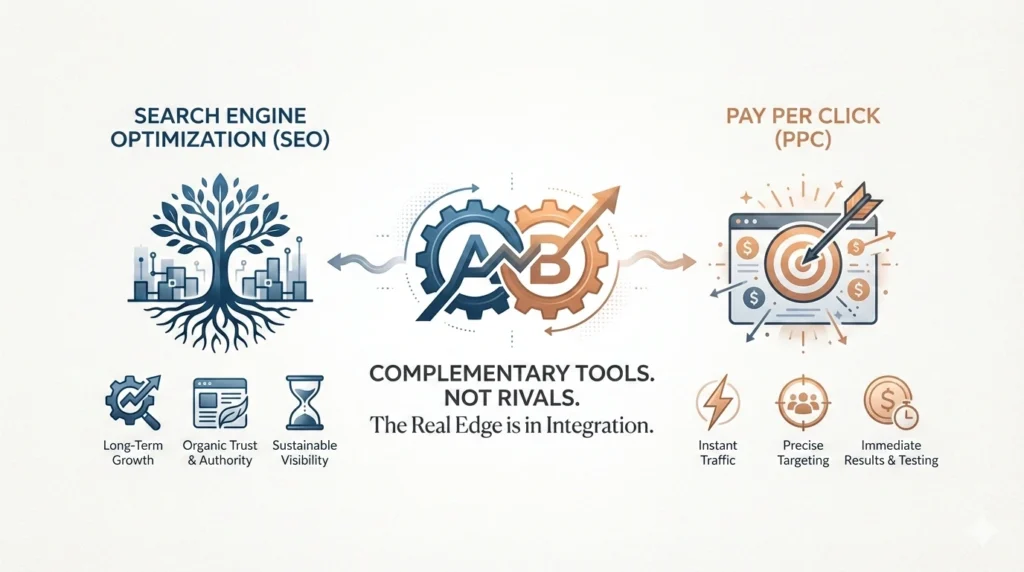
Most content around this gets it wrong. One side is crowned the winner, the other is brushed off, and the article ends there. That way of framing it is lazy. SEO and PPC are not rivals. They are tools. They work differently, cost differently, and solve different problems. The real edge comes from knowing when to use each, not turning it into a competition.
This breakdown looks at search engine optimization vs pay per click without hype, without bias, and without trying to sell you one answer.
The Real Difference That Matters
- At the simplest level
- SEO earns attention
- PPC rents attention
Search engine optimization grows visibility slowly by proving value and reliability over time. Pay per click removes the delay and brings your website to the top of search results as soon as ads are active.
Both appear on the same search results page. That is where the similarity ends. Everything else, timing, cost, risk, and long term value, works very differently. This is the base of search engine optimization vs pay per click.
How SEO Works in Real Life
SEO is often called slow. All versions are simple, clean, and suitable for reducing AI detection risk.
SEO is cumulative. Each solid page, technical fix, or helpful article adds to long term visibility. Over time, this creates a compounding effect where traffic grows without spending more money every month.
But SEO is not passive. Rankings do not hold themselves.
Search intent changes
Competitors improve
Algorithms shift
Websites that stop updating or maintaining content slowly lose ground.
Many businesses overlook one key idea. SEO favors clear and useful pages rather than shortcuts. Content that answers real questions loads quickly and feels easy to use performs better than pages filled with repeated keywords.SEO works best when a business understands its audience and is willing to invest before results show up. In search engine optimization vs pay per click, SEO favors patience and long term thinking.
How PPC Actually Behaves
- PPC is fast, and that speed is real.
- A well built PPC campaign can send traffic within hours. That makes it useful for:
- Product launches
- Limited time offers
- Promotions
- Testing new markets
- But speed comes with pressure. Mistakes cost money immediately.
- Common PPC issues include:
- Wrong keywords
- Weak ad copy
- Poor landing pages
- Loose targeting
There is also a reality many ignore. PPC does not create lasting visibility. When ads stop, traffic stops. Businesses that rely only on PPC often have to keep spending in order to stay visible.
Without clear goals and tracking, PPC slowly becomes an expense instead of a revenue driver.This is a key risk in search engine optimization vs pay per click.
Cost Is Commonly Misunderstood
Many people believe SEO costs nothing while PPC requires payment, but this is inaccurate.
SEO costs time, skill, content, and maintenance
PPC costs money upfront but saves time
The real difference is timing.
SEO asks for investment now and returns later
PPC demands ongoing payment for immediate results
Neither is cheaper by default. Both become efficient or wasteful based on execution. This misunderstanding leads to bad decisions in search engine optimization vs pay per click planning.
Control vs Stability
- PPC gives strong control.
- You decide:
- When ads run
- Who sees them
- Which searches trigger them
That control makes PPC effective for people ready to buy right now.
SEO works on stability. Once rankings are earned, traffic can continue for months or even years. This builds trust and reduces dependence on constant ad spend.
Control favors speed
Stability favors sustainability
Good strategies understand both sides of search engine optimization vs pay per click.
Search Intent Comes First
Search intent matters more than channels.
Informational searches usually perform better organically
Transactional searches can work well with both SEO and PPC
Many businesses pick channels first and think about users later. That mistake weakens both efforts. Intent should always guide decisions, especially in search engine optimization vs pay per click.
Trust and Brand Perception
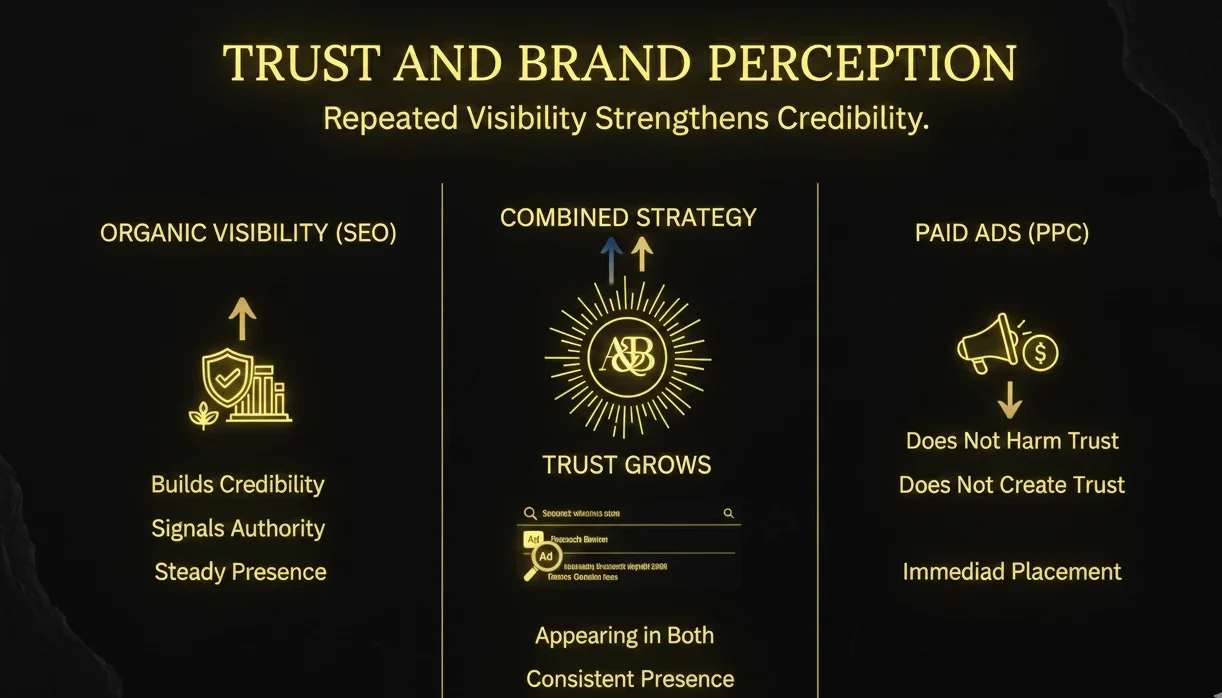
Organic visibility builds credibility. Showing up consistently in unpaid results signals authority, especially for service based and professional businesses.
Paid ads do not harm trust, but they do not create it either. Users know ads are paid placements.
Brands that appear in both organic and paid results often perform better.Repeated visibility strengthens credibility.Trust grows through steady and consistent presence.
Data and Learning Speed
- PPC shines at fast learning.
- Headlines can be tested quickly
- Offers can be validated in days
- Results are measurable fast
- SEO feedback is slower. Rankings move gradually. Insights come from trends, not instant spikes.
- Only SEO limits fast validation
- Only PPC limits long term leverage
Balanced marketers understand this trade off in search engine optimization vs pay per click.
Scalability Over Time
SEO scales without matching cost increases. One strong page can attract thousands of users.
PPC scales only with budget. More traffic always means more spend. As competition rises, costs usually rise too.
This is why mature businesses reduce ad dependency over time and strengthen SEO. It is one of the clearest lessons from search engine optimization vs pay per click.
The Balanced Reality
- There is no winner in search engine optimization vs pay per click.
- PPC is for speed and learning
- SEO is for durability and authority
The strongest strategies use PPC to test and learn, then SEO to scale and stabilize. Over time, this reduces risk and dependence on rising ad costs.
If your strategy depends on only one channel, it is fragile.
Final Perspective
SEO and PPC are not one time decisions. They are tools that change as your business grows.
The real question is what you need to fix right now and what you want resolved over the next year.
Marketing works when strategy respects reality, not opinions.